CDA-4101 Lecture 14 Notes
Scientific Notation for Real Numbers
- desire to separate the numeric range from the numeric precision
- floating point borrows from scientific notation
n = f x 10e
- "f" is the fraction (precision) and "e" the exponent (range)
Floating Point and Real Numbers
- floating point is used as a model for real numbers
- floating point is an approximation of the real numbers
- only a finite number of possible numbers
Floating Point Example
- only one digit and sign for fraction
- only one digit and sign for exponent
| Col. 0 | Col. 1 | Col. 2 | Col. 3 | Col. 4 | Col. 5 | Col. 6 |
| 0 | 0.0000007 | 0.0005 | 0.3 | 100 | 80000 | 60000000 |
| 0.000000001 | 0.0000008 | 0.0006 | 0.4 | 200 | 90000 | 70000000 |
| 0.000000002 | 0.0000009 | 0.0007 | 0.5 | 300 | 100000 | 80000000 |
| 0.000000003 | 0.000001 | 0.0008 | 0.6 | 400 | 200000 | 90000000 |
| 0.000000004 | 0.000002 | 0.0009 | 0.7 | 500 | 300000 | 100000000 |
| 0.000000005 | 0.000003 | 0.001 | 0.8 | 600 | 400000 | 200000000 |
| 0.000000006 | 0.000004 | 0.002 | 0.9 | 700 | 500000 | 300000000 |
| 0.000000007 | 0.000005 | 0.003 | 1 | 800 | 600000 | 400000000 |
| 0.000000008 | 0.000006 | 0.004 | 2 | 900 | 700000 | 500000000 |
| 0.000000009 | 0.000007 | 0.005 | 3 | 1000 | 800000 | 600000000 |
| 0.00000001 | 0.000008 | 0.006 | 4 | 2000 | 900000 | 700000000 |
| 0.00000002 | 0.000009 | 0.007 | 5 | 3000 | 1000000 | 800000000 |
| 0.00000003 | 0.00001 | 0.008 | 6 | 4000 | 2000000 | 900000000 |
| 0.00000004 | 0.00002 | 0.009 | 7 | 5000 | 3000000 | 1000000000 |
| 0.00000005 | 0.00003 | 0.01 | 8 | 6000 | 4000000 | 2000000000 |
| 0.00000006 | 0.00004 | 0.02 | 9 | 7000 | 5000000 | 3000000000 |
| 0.00000007 | 0.00005 | 0.03 | 10 | 8000 | 6000000 | 4000000000 |
| 0.00000008 | 0.00006 | 0.04 | 20 | 9000 | 7000000 | 5000000000 |
| 0.00000009 | 0.00007 | 0.05 | 30 | 10000 | 8000000 | 6000000000 |
| 0.0000001 | 0.00008 | 0.06 | 40 | 20000 | 9000000 | 7000000000 |
| 0.0000002 | 0.00009 | 0.07 | 50 | 30000 | 10000000 | 8000000000 |
| 0.0000003 | 0.0001 | 0.08 | 60 | 40000 | 20000000 | 9000000000 |
| 0.0000004 | 0.0002 | 0.09 | 70 | 50000 | 30000000 | |
| 0.0000005 | 0.0003 | 0.1 | 80 | 60000 | 40000000 | |
| 0.0000006 | 0.0004 | 0.2 | 90 | 70000 | 50000000 | |
Floating Point Example: Exceptions
- positive overflow - cannot express numbers larger than 9 x
109
- negative overflow - cannot express numbers smaller than -9 x
109
- underflow - cannot express numbers (aside from zero) between 1 x
10-9 and -1 x 10⁻⁹
- numbers in other ranges may not be exact, since much less dense
than real numbers (usually use rounding)
- spacing between numbers is not constant, but percentage wise it
does not vary.
- relative error due to rounding always about the same.
More Realistic Floating Point
- just extrapolate this same idea but to a much greater extreme
when we have more digits in range and precision
- increasing number of digits in fraction decreases the gap
between consecutive numbers
- increasing the number of digits in exponent increases the
numeric ranges
-
Normalized Numbers
Binary Scientific Notation
IEEE Standard 754
- IEEE worked in the 70's to standardize floating point arithmetic
- this includes both the representation and the
arithmetic
- remember, all finite precision arithmetic is an approximation
- there are many ways to do the math approximately (some better
than others)
- standard defined 3 formats
- single precision (32 bits)
- double precision (64 bits)
- extended precision (80 bits)
- extended precision mostly used internally in hardware to
reduce round-off errors (we shall speak of this no more)
IEEE 754 Representations
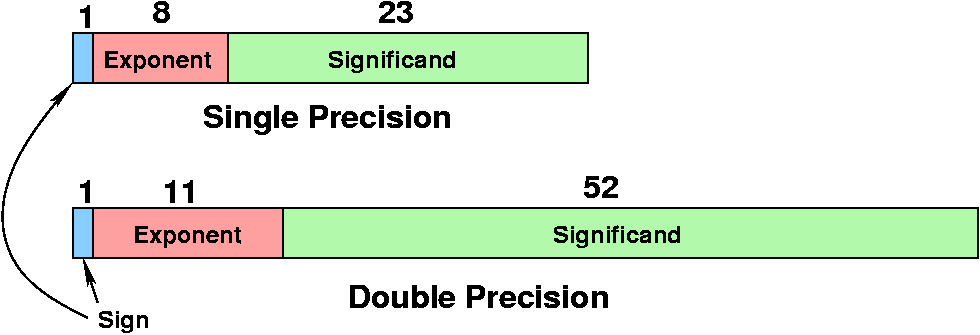
- one bit sign (for fraction)
- exponents in an "excess" representation (i.e., exponent's sign
encoded in here)
- radix 2 for fractions
-
- single precision (32 bits) - 1 sign + 8 exponent + 23
fraction (excess 127)
- double precision (64 bits) - 1 sign + 11 exponent + 52
fraction (excess 1023)
- big endian at bit level
IEEE 754 Special Cases
- maximum exponents (255 and 2047) not used for normalized
numbers (see below)
- exponent of zero not used for normalized
numbers (see below)
IEEE 754 Normalization
- shift fraction so leading one is always the only digit to left of
binary point
e.g., 11001.001 => 1.1001001
- This allows us to forego representing the binary point and let it
be implicit
    1          => 1
    1.101      => 1101
    1.00001    => 100001
- further,since this is binary and normalized, the 1 to the left of
binary point
will always be a one, so we can forego representing it as well and
leave it implicit in the representation.
    1.0      => 0
    1.0001   => 0001
    1.1      => 1
    1.1001   => 1001
- instead of calling the binary number the fraction, since there is
an implied leading one and implied binary point, it is called a
significand
- therefore, the significand "s" is always 1 <= s < 2
IEEE 754 Examples: Normalized Numbers
     0   1000 0011   0000 0000 0000 0000 0000 000   = 1 x 24 = 16

     0   0011 0001   0000 0000 0000 0000 0000 000   = 1 x 2-78 = 3.3087e-24

     0   1000 0001   0100 0000 0000 0000 0000 000   = 1.25 x 22 = 5
IEEE 75: Handling Errors
- it explicitly deals with overflow and underflow
- adds four other types of numbers to the normalized numbers
(total of 5 types)
- normalized
- denormalized
- zero
- infinity
- not a number
IEEE 75: Handling Underflow
- IEEE 754 uses denormalized numbers to gracefully handle underflow
- denormalized number exponent is 0 (really -127 or -2047)
- denormalized fractional part (23 or 52 bits):
- implicit digit to left of binary point is zero
- gives only 23 significant digits rather than 24
- smallest normalized number
0 0000 0001 0000 0000 0000 0000 0000 000 = 1.0 x 2-126 ~ 1.5 x 10⁻⁸
- largest denormalized number
0 0000 0000 1111 1111 1111 1111 1111 111 ~ 0.99999999 x 2-127 ~ 1.5 x 10⁻⁸
- smallest denormalized number
0 0000 0000 0000 0000 0000 0000 0000 001 = 2-23 x 2-127 ~ 7 x 10-46
- the more leading zeroes in a denormalized number the less
significant digits
- more graceful underflow as precision rather than jumping to zero
IEEE 75: Handling Overflow
- special representation for infinity
- positive and negative infinity
- exponent all 1's, fractional part all zeroes
   e.g.,
     0   1111 1111   0000 0000 0000 0000 0000 000   =  +Inf
     1   1111 1111   0000 0000 0000 0000 0000 000   =  -Inf
- this can be used in mathematical operations
       Inf + Inf = Inf
       Inf + Inf = Inf
       Inf + C = Inf
       Inf - C = Inf
       C / 0 = Inf
       -C / 0 = -Inf
       C / Inf = 0
IEEE 754: Two Zeroes
- like denormalized numbers, implicit digit to left of binary point
is zero
- exponent is zero, not 127 since otherwise this would be a
normalized number with implicit "1" to left of binary point
  e.g.,
     0   0000 0000   0000 0000 0000 0000 0000 000   =  +0
     1   0000 0000   0000 0000 0000 0000 0000 000   =  -0

     0   0111 1111   0000 0000 0000 0000 0000 000   =  1.0 x 20 = 1
- +0.0 and -0.0 compare equal to each other
- signed zeroes can help in determining the direction of overflow,
or sign of reciprocated infinity (see below)
      C / Inf  = 0
      C / -Inf = 0
      1 / +0 = Inf
      1 / -0 = -Inf
IEEE 754: Not a Number (NaN)